
The Stone Age has three periods. These periods are the Palaeolithic, Mesolithic and Neolithic. It is important to understand that 95% of human history has been in the Palaeolithic. This is a huge period of time which in Britain covers huge climatic and geological change. Revolutions in the environment softened by the vast depth of time. Britain in particular changes from being a savannah with animals that you would normally associate with modern Africa to ice field to a cold landscape similar to modern Russia. Across this canvas of time and space we can see the human evolution and its migration across the world.
We see various forms of the human race from scavenging Homo Habilis to exhaustion hunting Homo Erectus to the mighty Neanderthals. Of these various forms only one now remains and that is our type of human being a Homo Sapien. They lived around mammoths, sabre tooth tigers and Neanderthals. In fact there is excellent evidence gained from DNA analysis that modern humans living in the 21st century are descended from both populations. 3pc of our DNA comes from our Neanderthal ancestors.
Palaeolithic
Living in the Palaeolithic was very different to living in the modern day. In the modern day, we are consumers and our society is constructed to give us access to food and clothing. As for the Palaeolithic, they were not consumers but rather hunter gatherers living in a resource rich environment which they were experts in its exploitation.

In the modern day shops are built close to where the people live, our ancestors could not live in one place because their resources were the animals and the plants. These plants would grow with the seasons and the animals followed migratory paths which meant the people also had to be migratory following the reindeer herds and the seasonal pattens of trees and herbs.
Mesolithic
Living in the Mesolithic we see change after thousands of years continuity. At Star Carr in Yorkshire we find a village. It was unlikely to have been occupied all year around but was a site that was occupied on and off for hundreds of years. Situated next to both lakes and forest it was perfect for the Mesolithic lifestyle.

In the Mesolithic the mega-fauna, woolly mammoths, had become extinct and Britain had become an island after millions of years of being connected to the continent via a land bridge. The increasing temperature and Britain’s particular climate was perfect for the growth of forests and in these forests the people of Starr Carr hunted wild boar, deer, cows whilst in the lakes they had access to fish, fowl and useful plants. Whilst they remained hunter gathers mesolithic people dominated their landscape far more effectively than their palaeolithic ancestors.
Neolithic
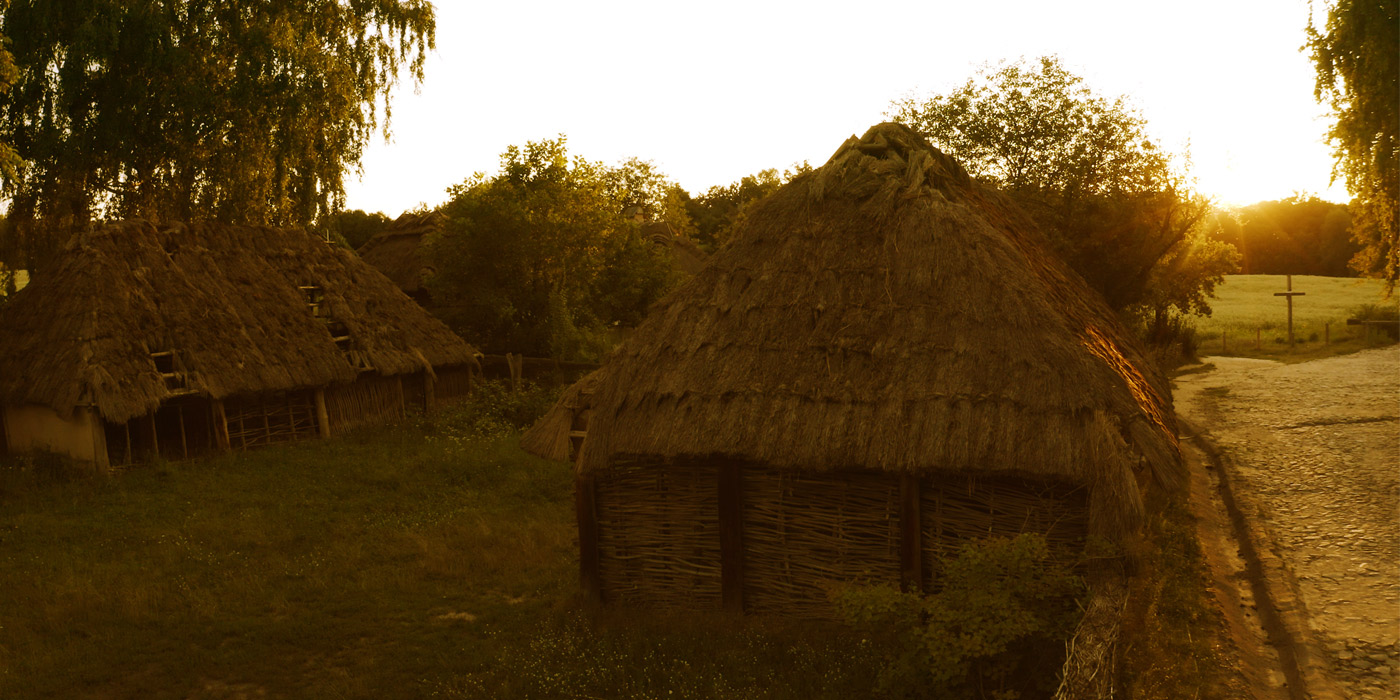
Finally the Neolithic represents a radical change in the lifestyle of people. Neolithic sites such as Skara Brae show how communities could develop around farming. Although hunting would still be an important part of the farming lifestyle the farmers could get the majority of their food from their fields. This provided the farmer with greater food security than any previous era which could be typified as ‘boom and bust’ lifestyles in contrast to the farmers who had food growing in their fields, food stored in their barns and food on their plates. Baring any disaster the farmer could live a very stable lifestyle. The rub comes not from the amount of food but from its quality.
We see from the archaeology that people living in a farming society suffer from malnourishment compared to their hunter gatherer ancestors who had less food but a greater variety. In the late stone age and early bronze age life expectancy and height diminish. In fact the life expectancy of a hunter gatherer is better than the life expectancy of a man living in mid 20th century New York.
Such is the price of security and progress…