
Sometimes learning about the ancient world can feel detached and hard to relate to, no matter how much you love history, it can seem almost like a fantasy world of places and legends that have no relation to us in the 21st century. But those places were real, and those people were our ancestors and luckily there are still places in the world where history is more tangible, where you can grasp it, physically, in your own hands.
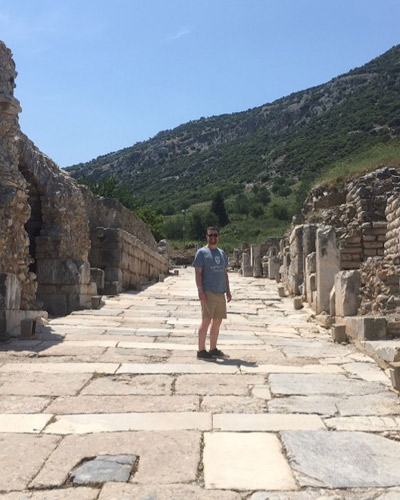
One of our passionate Historians, Stuart, was on holiday in Turkey. He said he couldn’t help combining work with leisure by visiting the remains of the ancient city of Ephesus.

Origins: Greeks, Persians, & Alexander the Great
Built in the 10th century BCE by the ancient Greeks on top of a city of an even older civilisation, Ephesus used to be home to the Temple of Artemis, one of the seven ancient wonders of the world. The Temple was described as the most wonderous of all the seven wonders of the world according to Antipater of Sidon, who helped compile an early version of the list of the seven wonders in the first place!
“I have gazed on the walls of impregnable Babylon along which chariots may race, and on the statue of Zeus by the Alpheus, and the hanging gardens and the colossus of the sun, and the huge labour of the high pymarids and the vast tomb of Mausolus; but when I saw the house of Artemis that mounted to the clouds, those other marvels lost their brilliancy, and I said, “Lo, apart from Olympus, the Sun never looked on aught so grand” – Antipater of Sidon

The Temple and the city had a very difficult and turbulent life over the years and were rebuilt several times. The first temple was destroyed by a flood in the 7th century BCE. In the 6th century BCE the Ephesians rebuilt the temple, even more magnificently than before, only for it to be burnt down in an arson attack!
Whilst the temple was being rebuilt for the THIRD time the city was under the control of the Persians, until it was liberated by the mighty Alexander the Great. The people had partially finished rebuilding the temple and it was so famous in the ancient world that Alexander even offered to fund the repair himself. However, the Ephesians, considering Alexander to be a living god, refused claiming it would not be right for a god to build a temple to another god.
Roman rule & Christian significance
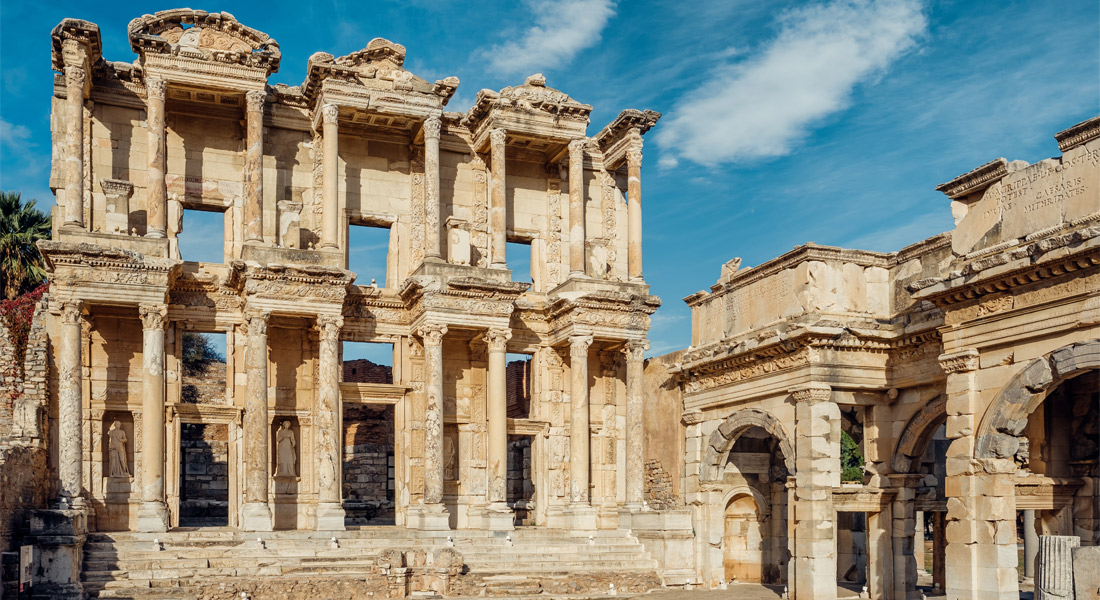
During the rise of the Roman Empire Ephesus fell into Roman control and many emperors left their mark on the city with new buildings including the third biggest library in the ancient world (seen below). Ephesus was such an important city that famous Romans would go to visit it, including General Mark Anthony and his Egyptian queen, Cleopatra.
As the Roman Empire weakened the Temple was destroyed AGAIN when the city was attacked in 268 AD by Goths, an East Germanic Tribe, not leather clad heavy metal fans. Once more the builders of Ephesus took out their tools and rebuilt the temple, however this time it was repurposed into a place of worship for the early Christians, until the Christians had to go into hiding due to persecution by the Romans.
The Early Christians developed secret symbols so that they could safely identify one another. One of those symbols is a six spoked wheel which has been found, by Archaeologists, carved into many stone across the city. In fact, Ephesus was so important to early Christians that apparently Mary, Jesus’ mother settled there at the end of her life.
Downfall of the City of Ephesus
The Temple and much of the city was destroyed one final time by an earthquake in 614 AD. The temple was not rebuilt but its stones were used to build homes and other buildings in the area. Eventually, in the 15th Century AD, people abandoned Ephesus completely and the city fell into total ruin, covered by mud and silt from floods and landslides, it was mostly forgotten.
It wasn’t until the late 19th Century AD that is regained some of its former fame and glory when archaeologists set out to find the city and temple. Excavations have continued almost nonstop for over 120 years and the archaeologists have tried to reassemble some parts of the city where they can.
Today visitors can see the layers of history with their own eyes, Medieval and early Christian sites on top of Roman baths and shops on top of ancient Greek temples and theatres. People can walk on the same stones trodden by Mark Anthony and Cleopatra, and you can even touch columns and walls carved by people up to 3000 years ago.
But you don’t have to go all the way around the world to see and feel history. There are many ancient sites here in the UK, in fact in most towns and villages there is at least one ancient building, the local chapel or church, many of which have parts dating from the 13th Century AD! It just goes to show that history is more than just books and museums (which are awesome too!) but can even be touched and felt in our surroundings.