
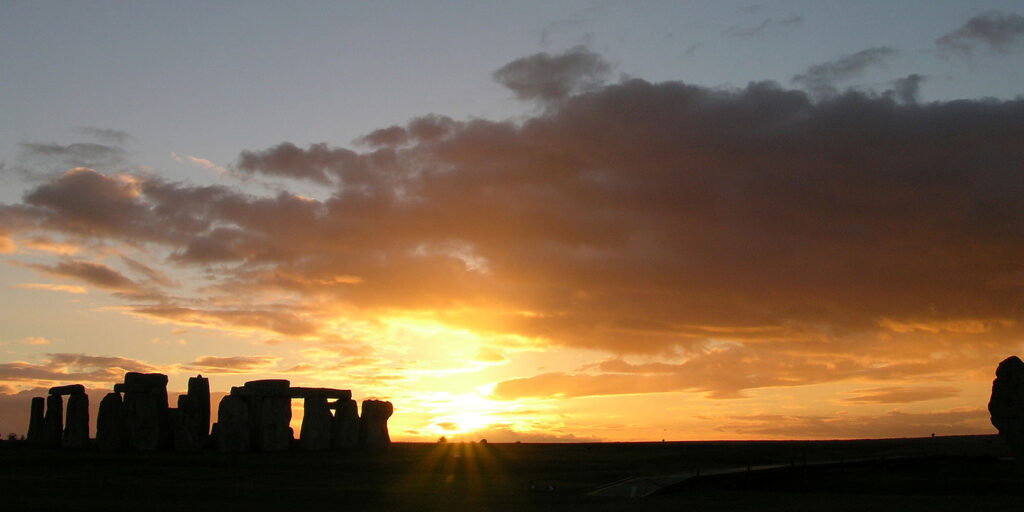
Midwinter
Midwinter has been a sacred time of the year since time immemorial. It is romantic to imagine our Stone Age and Bronze Age ancestors celebrating the midwinter sun, at a site such as Stone Henge, as it makes its return from decline into renewal. By the time we leave prehistoric Britain in the Iron Age we learn that the Romans are celebrating the midwinter with the worship of Sol Invictus, the invincible sun, and Saturnalia. In 274AD the Emperor Aurelian dedicated a temple to Sol Invica on the day of the winter solstice. Saturnalia celebrates the birth of Jupiter / Zeus and the rescue of his brothers and sisters from the stomach of his father Saturn, also known as Chronos. Part of the ritual celebration included the masters and slaves exchanging positions for the day. This is mirrored by the modern British Army where Christmas Day dinner is served by the officers to the men.
The Birth of Jesus
Sol Invictus, Mithras and Jesus all share midwinter as their birth. The earliest date for the commemoration of Jesus’ birth is likely 337AD but the first definite date of celebration is 352AD. Jesus’ date of birth was calculated as nine months after the annunciation which is the 25th March, the spring equinox. Traditionally, as far back as the Babylonians, the 25th of March is held to be the date that the creator started work on the universe.
The Romans and Greeks had winter traditions just as we have ours. A common sight at Christmas is a Nativity scene and the first was created by St Francis of Assisi in 1223AD and exhibited on Christmas day. We are all familiar with the scene. As hymns like “While Shepherds watched their Flocks by Night” or “Away in a manger” paint pastoral images that remain with us from childhood. Missing from nativity scenes should be the Three Wize Men and their gifts of Gold, Frankincense and Myrrh, who are commemorated on the 7th January on the Epiphany. These gifts predict Christs life and you never know where gifts will take the lucky recipient. In 1957 Richard Starkey received a drum set for Christmas. We know him better as Ringo Star.
Medieval Christmas
In Medieval times Christmas was one of the great feast days of the year. These days were not worked and were celebrated. Medievals were very keen on celebration and religion. In the alliterative poem ‘Sir Gawain and the Green Knight’ Gawain is keen on Christmas feasting, jokes and attending mass. If feasting is on your agenda for Christmas day you are in good company, King Edward IV held a lavish feast for two thousand people in 1482. But beware of indulging too much least you end up like poor King George V whose chair collapsed during his Christmas dinner speech.

Modern Christmas
Our modern Christmas traditions lie mainly with the Victorians. It was Charles Dickens who rescued an obscure Medieval feast day and wove about it traditions that we now mistake for ancient. At the same time Prince Albert was importing into Britain traditions from his German homeland. In the Victorian era we see the introduction of the Christmas tree, Christmas cards, Christmas presents and mistletoe. In the US a book called “A traditional English Christmas” proves very popular and presents millions of Americans with an idea of Christmas that was anything other than traditional but largely created. The Victorians were great innovators and these innovations include Carol concerts. Songs such as Silent Night were first sung on Christmas day in 1818. Later in 1939 we were introduced to the 9th reindeer Rudolf.
The Victorian innovations are not to everyones taste. If you are sick of Christmas games you might want to take a leaf out of Governor William Bradfords book and ban them, just as he banned games at Christmas in 1621. Or Oliver Cromwell and ban the whole thing altogether as the Puritans did in 1647. Baa Humbug as Scrooge would say.