
The Great Fire of London is an exciting topic for key stage one. Key stage one children love to learn about the buildings of London, how the fire started and the progress of the fire over those fateful days in September 1666.
It is very important to ask ourselves how we know so much about the great fire of London. When talking with children it is engaging to get out the materials which enable us to bring the events of the 17th century to life. These include primary sources such as the diary of Samual Pepys, archaeology and secondary materials such as textbooks.
The perfect storm for a great fire
The whole event was a disaster waiting to happen. London was built from wooden houses to preserve the wood against rot they would coat the wood in pitch. This pitch was incredibly flammable. The houses were also very close together this meant the fire could leap from house-to-house.
17th-century firefighting techniques were rudimentary but effective. The most important technique was pulling down burning houses before they could ignite their neighbours. This was done by using fire hooks, axes and other demolition equipment. If the house could be saved then water could be used to douse the flames. By law this equipment could be found in the local church to which community minded citizens would run when they heard muffled bells.
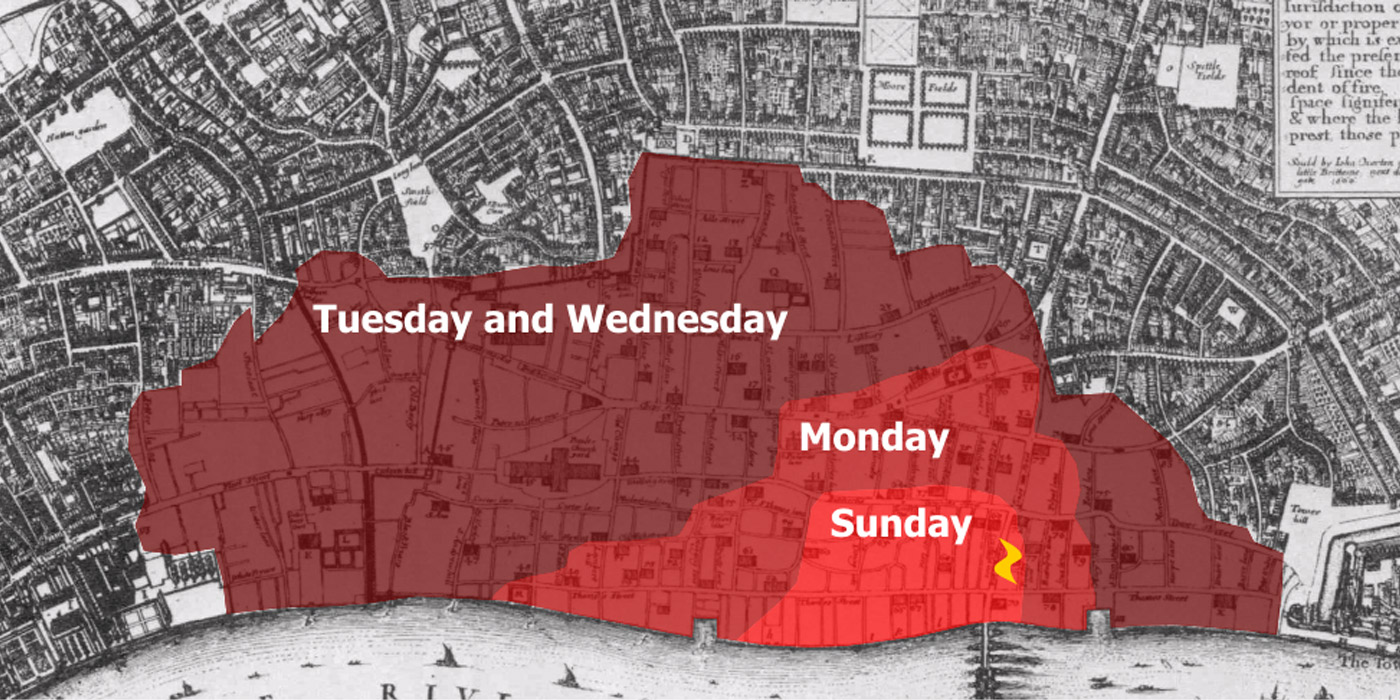
The flames were helped by the Mayor Lord Bloodworthy who refused permission to pull down the neighbouring houses thus creating a fire break. He did not want to be responsible for paying for the damage. The fire was able to take a hold whilst he neglected his duty. He even used a very rude expression to describe how small he thought the fire was. Very soon the fire spread down to the London docks where flammable and explosive materials were being stored.
The great fire was helped immensely by the weather it had been hot and dry throughout the summer. During the actual period of the fire there was a wind which fed the flames and unable to sparks to fly. During the first few days there was panic on the streets of London with people more interested in saving their goods than fighting the flames, this changed when Charles II put his brother the Duke of York in charge of the streets. The life guards under his command insured first that the flames were being fought using bucket chains and second protected foreigners who were being accused of starting the fire.
Ashes & aftermath
By the end of the fire, 80% of the city had been destroyed. This included churches, houses, businesses and famously of all the cathedral of Saint Pauls. With so many people displaced Charles was frightened of an antimonarchist riot. This did not materialise probably because of the effective relief efforts. During the rebuilding of London laws were in acted to ensure proper breaks between houses and that the houses would be made of stone rather than word.
The Great Fire of London is an exciting day provided by Portals to the Past for year one. Like all portals experience days it is a in gauging and inclusive experience. Children are you encouraged to act, to learn through play in this curriculum enrichment atmosphere.